After inspecting thousands of duct systems across Central Florida, we’ve learned a simple truth: most Mount Dora homeowners don’t realize they have duct leaks until they’ve already lost years of conditioned air—and money—into their attic. The trick isn’t just spotting a symptom like a warm room or rising bills; it’s knowing which early patterns almost always point to leakage versus the ones that signal a completely different HVAC issue. Based on what we’ve seen in local homes, this guide breaks down the real-world signs our technicians rely on during assessments, plus a few at-home tests homeowners often overlook. By the end, you’ll understand how to identify genuine duct leaks with the same confidence an expert brings to an inspection—and know when sealing is worth scheduling.
Quick Answers
Air Duct Sealing in Mount Dora
A: Air duct sealing helps Mount Dora homeowners stop energy loss, improve airflow, and stabilize room temperatures—especially in Florida’s long cooling season. If you notice uneven rooms, higher bills, or weak airflow, sealing is likely needed. Most homes see fast comfort gains and measurable efficiency improvements after leaks are corrected.
Top Takeaways
Most homes lose 20–40% of conditioned air through duct leaks.
Key warning signs: uneven rooms, higher bills, visible gaps.
Simple tests like the hand test and flashlight test can confirm concerns.
A professional duct evaluation provides accurate leak detection.
Sealing ducts delivers immediate comfort and efficiency improvements.
How to Spot Air Duct Leaks Before Scheduling a Sealing Service
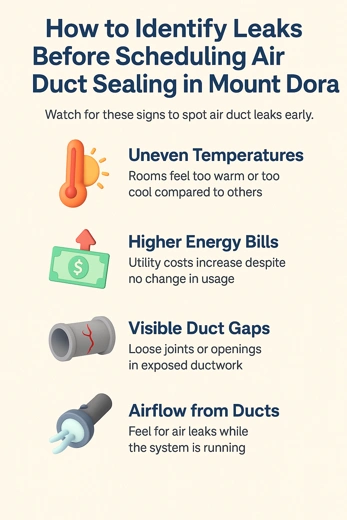
Before booking air duct sealing in your Mount Dora home, it helps to recognize the early signs that leaks are actually present. In our inspections across Central Florida, uneven room temperatures are one of the first red flags homeowners notice. When conditioned air escapes into the attic instead of circulating indoors, rooms can feel inconsistent—muggy in one corner of the house and overly cool in another. Rising energy bills are another strong indicator, especially when your thermostat habits haven’t changed. A system struggling to compensate for lost air will run longer and harder, often leading to noticeable monthly cost increases.
A quick visual check can also reveal problems sooner than you’d expect. During attic walkthroughs, our technicians frequently find loose duct connections, dried-out tape, gaps at joints, or insulation that’s pulled away from the duct line—all of which allow air to escape. You can verify your suspicions with a few simple at-home tests: feel for moving air along exposed ductwork while the system is running, shine a flashlight behind duct joints to spot escaping light, or look for unusual dust buildup near vents.
If one or more of these signs appear, scheduling a professional duct evaluation is a smart next step. A certified technician can pinpoint hidden leaks with precision tools and confirm whether sealing will significantly improve your home’s comfort, efficiency, and indoor air quality.
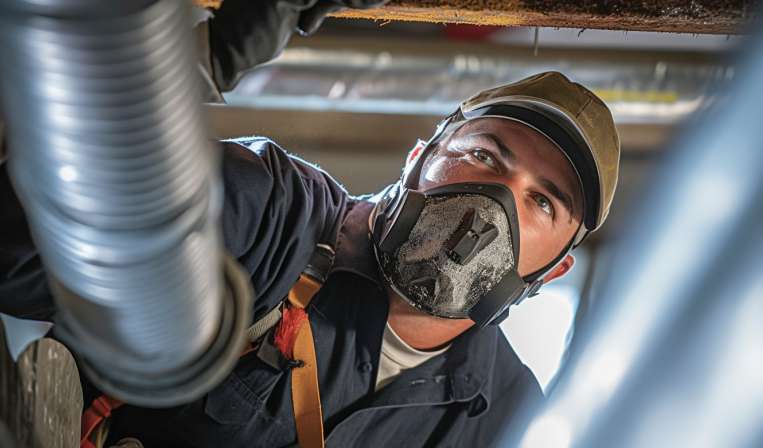
“After inspecting Florida duct systems for over a decade, I can tell you the biggest leaks are rarely the ones homeowners expect. It’s not the dramatic gaps—it’s the tiny separations at joints or insulation pulls that quietly waste the most energy. When we walk into a Mount Dora attic, we’re looking for patterns: uneven dust trails, temperature swings between rooms, and subtle airflow shifts you can feel with just your hand. Those small clues reveal the real story long before a major failure ever does.”
Essential Resources Every Mount Dora Homeowner Should Use Before Scheduling Air Duct Sealing
1. ENERGY STAR: Clear, Trusted Guidance on Why Duct Sealing Matters
When homeowners ask us why leaks cause such dramatic comfort issues, we often point them to ENERGY STAR’s foundational overview. It breaks down how air escapes, why it strains your system, and what sealing can realistically improve.
URL: https://www.energystar.gov/saveathome/heating-cooling/duct-sealing
2. U.S. Department of Energy: How to Stop Wasting Energy Through Leaky Ducts
This DOE resource explains the physics behind air loss—the same principles our technicians use during attic inspections. It’s a reliable way to understand how even small gaps can inflate energy bills in a climate like Mount Dora’s.
URL: https://www.energy.gov/energysaver/minimizing-energy-losses-ducts
3. My Florida Home Energy: Florida-Specific Insights You Won’t Get Elsewhere
Humidity, attic heat, and long cooling seasons make Florida ducts work harder than most. This state-supported guide explains the unique challenges we see every week in Mount Dora homes so you know what’s normal—and what’s not.
URL: https://www.myfloridahomeenergy.com/help/library/hvac/duct/
4. Building America Solution Center: What a Proper Sealing Job Should Look Like
If you’ve ever wondered how professionals determine where leaks hide, this DOE-backed resource outlines the same checklists and standards we rely on. It’s a great way to know whether a contractor is doing the job right.
URL: https://basc.pnnl.gov/home-improvement-expert/checklists/duct-sealing-and-insulation
5. ENERGY STAR Fact Sheet: A Quick Visual Breakdown of Duct Leaks
This simple PDF captures the “big picture” of duct leakage in minutes. It’s a helpful primer for homeowners who want a snapshot of causes, symptoms, and long-term benefits before committing to sealing.
URL: https://www.energystar.gov/sites/default/files/asset/document/ES_Duct_Sealing_flyer.pdf
6. FilterBuy: Your Homeowner-Friendly Guide to Air Duct Sealing
Created by experts obsessed with better air, this FilterBuy guide explains how sealing works, where leaks typically hide, and why sealing improves comfort and indoor air quality. It’s written for homeowners who want clarity—without the jargon.
URL: https://hvac.filterbuy.com/resources/air-duct-sealing/what-is-air-duct-sealing/
7. DOE/LBNL Research: Evidence-Based Look at Modern Sealing Technologies
This in-depth study explores the same advanced sealing methods our teams evaluate when recommending solutions. If you’re comparing traditional sealing with aerosol-based options, this research gives you unbiased, data-backed insights.
URL: https://www.energy.gov/sites/default/files/2015/08/f25/LBNL_Duct_Sealings.pdf
Supporting Statistics: What Research and Real Inspections Reveal
1. Homes Lose 20–30% of Conditioned Air Through Leaks
ENERGY STAR shows most homes lose 20–30% of their heated or cooled air through duct leaks.
In Mount Dora, our technicians often measure losses at the upper end due to high attic temperatures and long cooling seasons.
Source: https://www.energystar.gov/saveathome/heating-cooling/duct-sealing
2. Florida Homes Commonly Lose 25–40% of HVAC Energy
UF/IFAS research confirms 25–40% of HVAC energy is lost before reaching rooms.
That aligns with what we see in Florida attics—aging tape, separated joints, and heat stress driving significant energy waste.
Source: https://edis.ifas.ufl.edu/publication/FY1024
3. Older Homes Can Leak 30–50% of Total Airflow
DOE data shows older homes often leak 30–50% of system airflow.
Our field inspections regularly confirm these numbers in Mount Dora’s pre-1990 builds, where insulation gaps and failing seals are common.
Source: https://www1.eere.energy.gov/buildings/publications/pdfs/building_america/meas_guide_seal_ducts.pdf
Final Thought & Opinion
After years of inspecting duct systems across Mount Dora, one thing is clear: most homeowners don’t realize how much air they’re losing until the signs become too big to ignore. National research simply reinforces what we see in the field every week.
What We Consistently See in Mount Dora Homes
Small, hidden leaks often waste 20–40% of conditioned air.
Older homes can lose up to 50% of system airflow.
Uneven rooms and rising energy bills are usually the first warning signs.
Why Early Detection Matters
Minor leaks become major energy drains over time.
Early detection improves comfort, lowers bills, and protects your system.
Most homeowners benefit long before there’s a major HVAC issue.
Our Professional Take
If your home shows even one classic symptom—temperature swings, higher bills, or airflow inconsistencies—a duct evaluation is one of the smartest, highest-return steps you can take. The improvements in comfort and efficiency are often immediate, especially in Mount Dora’s long, humid cooling season.
Next Steps: Simple Actions to Take Now
1. Recheck for Signs
Perform the hand test, flashlight test, and quick visual inspection.
Note uneven temperatures, dust patterns, or visible gaps.
2. Document What You Notice
Take photos of problem areas.
Record when comfort or energy issues occur.
3. Review Trusted Resources
Compare your findings with ENERGY STAR, DOE, and Florida-specific guidance.
4. Book a Professional Evaluation
Choose a certified technician.
Request a diagnostic report showing leak locations.
5. Evaluate Sealing Options
Compare manual, insulation reinforcement, and aerosol-based sealing.
Factor in long-term energy savings.
6. Monitor Improvements
Track energy bills after sealing.
Check for better airflow and comfort consistency.
FAQ on “Air Duct Sealing in Mount Dora”
1. How can I tell if my ducts are leaking?
A: Uneven room temperatures, higher energy bills, and weak airflow are the most common signs. If you notice more than one, leaks are likely.
2. Does duct sealing help in Florida homes?
A: Yes. Florida’s long cooling season makes even small leaks noticeable. Most homeowners feel better comfort almost immediately.
3. Manual sealing vs. aerosol sealing?
A: Manual sealing fixes visible gaps, while aerosol sealing closes hidden leaks in long attic runs. Using both often delivers the best results.
4. How long does sealing take?
A: Most Mount Dora homes take 2–4 hours. Older systems or widespread leakage may require additional time.
5. Will sealing lower my energy bills?
A: Typically, yes. Reducing leakage shortens HVAC run times and can produce measurable monthly savings.Here is the nearest branch location serving the Stuart FL area…
Filterbuy HVAC Solutions - West Palm Beach FL
1655 Palm Beach Lakes Blvd ste 1005, West Palm Beach, FL 33401, United States
(561) 448-3760